Rule 103 of the North Carolina Rules of Evidence contains nearly identical language to the same Federal Rule of Evidence prior to its amendment in 2000. Originally set to be effective on October 1, 2003, the General Assembly amended former Rule 103 by adding the following language to subsection (a)(2): “Once the court makes a definitive ruling on the record admitting or excluding evidence, either at or before trial, a party need not renew an objection or offer of proof to preserve a claim
[...]
With the first super majority the Republican Party has seen in the North Carolina General Assembly in over a century and the lack of a Democratic veto power in the Governor seat, the state is sure to see a change in its political agenda and legislation in the coming years. Among the proposed legislation, one hot topic in particular has been Bill 589, otherwise known as the Voter ID Bill. The Voter ID Bill was proposed on April 4, 2013, and is a more lenient version of a similar bill that was
[...]
I doubt there’s a prosecutor or plaintiff’s lawyer in the state who would give up the opportunity to be the last lawyer to address the jury in a contested case. Getting the last word is important. The principle of recency tells us the people tend to remember what they hear last. What better way to send the jury into the deliberation room that with your powerful closing argument ringing in their ears? But there’s another principle of persuasion that seems to get overlooked in many
[...]
In 1935, desperate to find a way to fairly and efficiently resolve labor disputes, Senator Robert F. Wagner of New York introduced a bill in Congress. The bill, soon to become known as the Wagner Act, was signed into law in July of that year. The Wagner Act created the National Labor Relations Board (NLRB), an independent federal agency that still exists today. One of the original purposes of the NLRB was to be an enforcement mechanism for protecting certain employee rights, such as the
[...]
The North Carolina House of Representatives recently filed a controversial bill that would allow superior court clerks, magistrates, sheriffs with at least ten years of experience, and law enforcement officers with 25 years of experience to become District Court judges. House Bill 397, known as the “Expand District Judge Eligibility” bill, is sponsored primarily by Justin Burr of Albemarle, Jeff Collins of Rocky Mount, and Mike Stone of Sanford. The bill rewrites Section 22 of
[...]
Note from the Editors: Recently, the Campbell Law Observer hosted a write-on competition to recruit new staff writers. Each student was to discuss the role of changing technology in the legal profession. Below, you will find the article that received the second-highest score from the editorial board. For better or for worse, technology continues to change the legal landscape on an immense scale. Technology has transformed the practice of law into something that would be unrecognizable
[...]
Four Loko is a fruit-flavored, alcoholic drink popular on college campuses because of its low cost and high alcohol content. The beverage was invented by three Ohio State University students in 2005 and has been nicknamed “blackout in a can.” In the past few years, the beverage has received extensive media attention following several alcohol-related incidents. In October 2010, nine college students in Washington State were hospitalized after drinking Four Loko. Officials initially
[...]
Note from the Editors: Recently, The Campbell Law Observer hosted a write-on competition to recruit new staff writers. Each student was to discuss the role of changing technology in the legal profession. Below, you will find the article that received the highest score from the editorial board. Next week, we will publish another student’s write-on prompt in an attempt to display two perspectives. Good intentions can sometimes lead to grave consequences. Situations arise every day in
[...]
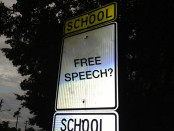
Until recently, most free speech cases concerning students have been at the middle school level and above. While courts have made it clear that students do not shed their rights at the schoolhouse gate, courts have also made it clear that an elementary school student does not necessarily share the same rights as a middle school or high school student. Defining free speech rights of elementary students can prove daunting, but many courts favor the conclusion that viewpoint discrimination
[...]
Recent increases in violent acts in schools have left school officials struggling to find a balance between student safety and student liberty. Fraser recognized that students’ constitutional rights in public schools “are not automatically coextensive with the rights of adults in other settings,” [ref] 1. Bethel Sch. Dist. v. Fraser, 478 u.s. 675, 682 (1986). [/ref] but the court also held in Tinker that school officials must ensure a student’s constitutional rights are not
[...]
Believe it or not, we are still living in a time of war. While the White House has declared an end to the war in Iraq, and the war in Afghanistan is “winding down,” the truth is that we still have American soldiers deployed in hostile areas. Many of our service members return from deployment with experiences the rest of us at home will never see. To recognize these unusual experiences, the United States has a system of military honors to recognize those service members who conduct
[...]
It is commonly known—whether from legal training or from the 1999 thriller “Double Jeopardy”—that individuals cannot face multiple criminal punishments for the same offense. The line between civil penalty and criminal punishment can apparently be a fine one. Courts have realized that certain civil penalties, while not formally characterized as punitive, can amount to criminal punishment and thus violate the double jeopardy clause of the Constitution. In January 2013, the North
[...]
In one of his first major acts as governor, Pat McCrory signed into law a bill that will mark a dramatic overhaul in North Carolina’s unemployment system. The bill, which McCrory signed on February 19, is the second bill he has signed since taking office in January and will go into effect on July 1 of this year. Currently, the unemployment rate in North Carolina is around 10 percent – remaining consistently higher than the national unemployment rate of 8.5 percent. The state’s
[...]
Gambling has long been a problem faced throughout the United States. Although outright gambling has been banned almost everywhere, new forms of gambling continue to pop up. One of the more recent manifestations is the advent of the Internet sweepstakes. Internet sweepstakes have grown in popularity in North Carolina over the last five to ten years, and the North Carolina General Assembly has made repeated attempts to stop the spread and use of these gambling operations. At its most
[...]
It was a Thursday afternoon, and I was contemplating a difficult and nuanced issue of evidence law. My eyes were closed in deep concentration… OK, so I was napping after a big lunch. My “contemplation” was interrupted by a third-year student who had done quite well in Evidence the previous semester and was interning in the District Attorney’s office under the third-year practice rule. He was visibly upset and needed to talk. The District Court judge before whom he was trying a
[...]
«
1
…
75
76
77
78
79
…
85
»