
Do the Trump Administration’s changes to SNAP undercut due process rights? During the government shutdown in September and October 2025, SNAP benefits temporarily went unfunded, leading multiple federal judges to order the U.S. Department of Agriculture (USDA) to continue payments using contingency funds. The Trump administration subsequently worked quickly to appeal lower federal court orders. Earlier that year, Trump’s Big Beautiful Bill limited eligibility for SNAP and required states to contribute more funding to the program. More recently, President Trump’s officials suspended SNAP for thousands in Minnesota, following a dispute over compliance with disclosure requests. During a cabinet meeting, Trump’s administration threatened to do the same to other Democratic-led states. These disputes remain in litigation, and amidst the political debate, there could be a loss of property rights.
The Shutdown and the Bill
The U.S. Department of Agriculture (USDA) runs the Supplemental Nutrition Assistance Program (SNAP). On October 24, 2025, the USDA informed states that it would not fund SNAP benefits during the government shutdown in November. Democratic-led states sued to restore the funding, and judges ruled that the Trump administration must continue funding SNAP through its reserves. The Trump administration responded that it would only fund up to 65% of the expected benefits. The Supreme Court put a lower federal court’s order to fund full benefits on hold. In response, some states issued nothing, some accepted partial federal benefits, and others sent their own funds to SNAP recipients or nonprofit food banks. Once the government reopened in November, Congress passed legislation that fully funded SNAP benefits for the federal fiscal year, which lasts through September.
Last July, Trump’s One Big Beautiful Bill Act (OBBBA) significantly altered SNAP by expanding work requirements, limiting citizenship eligibility requirements, and shifting greater costs to the states. According to Katie Bergh, a senior policy analyst for food assistance at the Center on Budget and Policy Priorities, seniors, disabled individuals, working families, and non-citizens are likely to be the most impacted groups. Before the Bill, adults aged 18 to 54 without dependents had to work at least 80 hours per month to be eligible for benefits. The Bill expanded this requirement to include adults up to 64 years old and eliminated existing exemptions for Veterans, homeless individuals, and those who recently aged out of foster care. The Bill also limits eligibility to lawful permanent residents and U.S. citizens. Further, the Bill requires states to pay up to 15% of benefit costs – depending on the state’s payment error rate – and an additional 25% for administrative costs. States may cut funding to other areas, increase taxes, or restrict SNAP eligibility to account for the increased cost burden. The Congressional Budget Office estimates that Trump’s Big Beautiful Bill will cut SNAP funding by around $186 billion through 2034.
A Snapshot of SNAP
Numerous factors affect whether an individual is eligible for SNAP, including citizenship status, work requirements, and income thresholds. U.S. citizens and certain lawfully present non-citizens are eligible for SNAP, while undocumented non-citizens are ineligible. Lawfully present non-citizens must have lived in the U.S. for at least five years, receive disability-related assistance, or be under 18 to receive SNAP benefits. Eligible recipients must also meet specific work requirements, unless they are children, seniors, mentally or physically unable to work, or otherwise exempt. Income limits further restrict eligibility; individuals must have a gross income at or below 130% of the poverty level, and their net income must be at or below 100% of the poverty level.
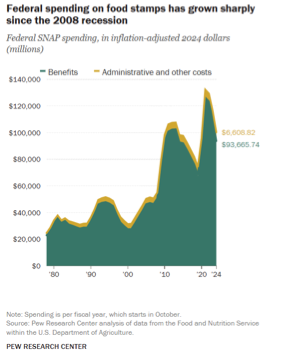
SNAP serves many individuals, but it is a costly program. About 42 million Americans, or 12%, rely on SNAP to buy groceries. On average, recipients receive $190 per person per month. Meanwhile, the average monthly cost of groceries ranges[AS2] from about $300 to $500, depending on budget, gender, and age. The government spent nearly $65 billion on SNAP benefits during the first eight months of fiscal year 2025, 4.7% more than the same period in 2024.
Fraud or Food?
Concerns about fraud have long intersected with debates over SNAP administration. Last December, President Trump’s administration said it would withhold SNAP benefits from recipients in Democratic-controlled states. To receive the benefits, the states had to provide the names and immigration statuses of SNAP recipients.
Agriculture Secretary Brooke Rollins says that state’s “cooperation [with data requests] is needed to root out fraud” As of December 2, 2025, 29 states complied, 21 states have not, and 22 states “sued to block the order.” According to Rollins, USDA found over 226,000 fraudulent benefit claims and 691,000 fraudulent transactions were approved in 2025, the first quarter of 2025, costing the government $102 million. Rollins stated that 186,000 deceased people are receiving benefits and 500,000 individuals are receiving benefits more than once, according to information from states that complied with Trump’s order. However, the USDA has not released a detailed public report verifying these numbers or explaining how they were calculated.
Federal audits and program monitoring may provide context for these claims. The U.S. Government Accountability Office reported that improper payments accounted for 11.7% of SNAP payments in fiscal year 2023, or about $10.5 billion dollars. According to the USDA SNAP “Scorecard,” its quarterly report tracking improper payments, SNAP reported 10.3%, or about $9 billion, of improper payments in fiscal year 2024. The chart is depicted below. Rollins also stated that the administration’s effort to address fraud was “an unintended consequence” of the 43-day government shutdown, which she attributed to Democrats, and argued that the shutdown drew increased attention to SNAP and created an opportunity to reevaluate the program.
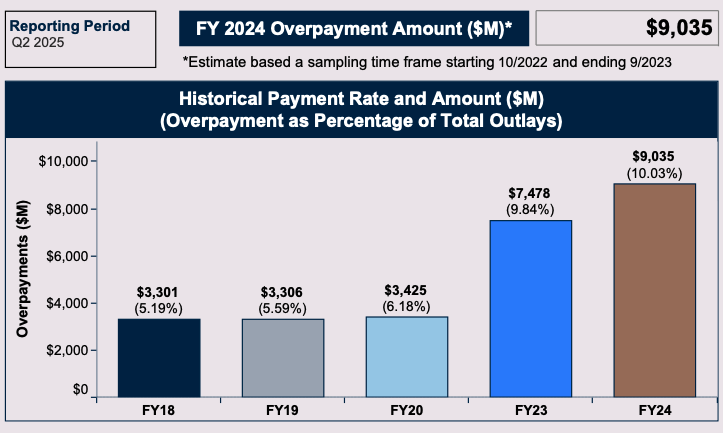
U.S. Department of Agriculture, Food and Nutrition Service. (2025)
Democrats offered a different perspective U.S. Rep. Jahana Hays argued that SNAP recipients rely on the program to buy food, not game the system. Other Democrats, like Claire Lancaster, a spokesperson for Democrat Minnesota Governor Tim Walz, criticized the Trump administration’s approach. Lancaster argued that federal actions such as threatening highway funding or food assistance could “raise prices and harm families.”
Recent SNAP enforcement measures demonstrate the tension between preventing improper payments and protecting recipients’ due process rights. Questions about timely notice, continuation of benefits during disputes, and the division of responsibilities between federal and state authorities make administration complicated, and these issues remain contested in both litigation and policy discussion.
The Legal Debate Ended in a Snap
A case that began in lower federal courts was later appealed to the Supreme Court, which did not take up the merits of the case. The U.S. District Court of Massachusetts found that the USDA is statutorily mandated to use previously appropriated reserves when necessary. Similarly, the U.S. District Court in Rhode Island ordered the Trump administration to pay full SNAP benefits because failing to do so is “arbitrary and capricious.” The court stated that, “the administration is withholding full SNAP benefits for political purposes. Such ‘unjustifiable partisanship’ has infected the USDA’s decision-making, rendering it arbitrary and capricious.” The Supreme Court stayed the two federal court decisions. Its decision did not specifically address the lower courts’ reasonings.
This modern dispute reflects the ongoing tension between the legislative authority to authorize SNAP benefits and recipients’ due process protections. In the 1980s, the Court held in Atkins v. Parker that statutorily authorized SNAP benefits are considered property for Fifth Amendment purposes, but legislative adjustments do not constitute a due process violation. In Atkins, Congress amended the Food Stamp Act, limiting eligibility for SNAP benefits. Congress lowered the amount of a household’s earned income that was deducted in determining eligibility from 20% to 18%. This reduced or eliminated benefits for families whose income was close to the eligibility threshold. The Department of Agriculture issued regulations to implement the change and instructed states to notify SNAP recipients. The Massachusetts Department of Public Welfare notified SNAP recipients of their right to request a hearing and that benefits would be reinstated if they did so within 10 days of the notice. Here, the Court held that Congress had the plenary power to change SNAP benefits and that the notice was sufficient.
Still, SNAP recipients must receive timely and adequate notice of an adverse action and can continue to receive benefits while they await a hearing. According to 7 C.F.R. § 273.13(a)(1), notice is timely if it provides at least 10 days from the date the notice is mailed to the date of the action to reduce or terminate benefits. Under 7 C.F.R. § 273.13(a)(2), notice is adequate if it:
“[E]xplains in easily understandable language [t]he proposed action; the reason for the proposed action; the household’s right to request a fair hearing; the telephone number of the SNAP office (toll-free number or a number where collect calls will be accepted for households outside the local calling area) and, if possible, the name of the person to contact for additional information; the availability of continued benefits; and the liability of the household for any over issuances received while awaiting a fair hearing if the hearing official’s decision is adverse to the household. If there is an individual or organization available that provides free legal representation, the notice shall also advise the household of the availability of the service.”
While SNAP recipients are not guaranteed to receive the same amount continually, they are entitled to notice, an opportunity to be heard, and a reinstatement of benefits while their hearing is pending.
An Order Left Unsettled
Future courts are left to decide whether SNAP benefits should be a due-process right and whether the current system adequately protects those rights. Individuals can still sue the federal and their state government for changes to SNAP benefits. Similarly, individuals can sue the USDA when Congress fails to fund SNAP, and they can sue states when those states fail to comply with federal guidance. However, relief may be limited to injunctions rather than money damages.
In recent litigation, the Supreme Court did not address the substantive due process arguments or resolve whether actions such as the USDA funding decision or the BBB eligibility changes violate due process. Given the number of affected individuals and states, the issue may reach the courts once again, giving the Court a second chance to clarify whether the existing protections are sufficient or open to abuse.