Should schools allow parents to pull their children out of classes that teach pro-LGBTQ+ material? The Supreme Court said “yes” in Mahmoud v. Taylor. The Montgomery County Public School (MCPS) District in Montgomery County, Maryland, is committed to teaching inclusivity, so it developed a pro-LGBT+ curriculum designed to disrupt students’ thinking. Students’ parents sued MCPS over the LGBTQ+ curriculum’s no opt-outs policy, and the dispute went all the way to the Supreme Court. The Court decided that, while schools have a duty to provide a well-rounded curriculum, parents have a right to direct the education of their children based on religious beliefs. The decision could be a burden for school districts that aim to include all backgrounds, such as MCPS. For parents who cherish the right to educate their children in accordance with their own religious beliefs, the decision is a blessing.
At the beginning of the 2022-2023 school year, MCPS announced the integration of the LGBTQ+ inclusive books into its curriculum with the option for parents to opt their children out of those lessons. It only took the district a couple of months before they completely removed the opt-out option due to the vast number of parent requests. The plaintiffs in this case consisted of four sets of parents and an unincorporated association of parents and teachers called “Kids First.” Kids First was specifically “formed to advocate for the return of parental notice and opt-out rights in [MCPS].” The parents were from a variety of religious backgrounds including, Muslim, Catholic, and Ukrainian Orthodox. Further, these parents asserted that the Board’s opt-out policy violated their right to free exercise of religion. The parents sought injunctive relief, which is a court order that would prevent the Board from requiring their children to “read, listen to, or discuss” these books.
The New Curriculum
Prior to the introduction of the LGBTQ+ books, the MCPS Board evaluated its curriculum and found that it failed to represent the County’s population, namely because the books in the curriculum did not include LGBTQ+ characters. To develop a more representative curriculum, the Board sought books that reinforced or disrupted “heteronormativity, cisnormativity, and hierarchies that uphold the dominant culture.” In total, there were 13 “LGBTQ+ inclusive texts” that the Board selected, but the issue in this lawsuit is the five storybooks meant for kindergarten through fifth-grade classrooms. The books feature transgender and gender assignment conversations, including children using gender neutral bathrooms and pronouns, discussions of same-sex relationships, messages that gender is chosen rather than assigned, a parent reassuring a child that her uncle can marry another man, and a female child identifying as a boy and asking her mother to help her become a boy.
Per school policy, the teachers are required to incorporate the LGBTQ+ books into their lesson plans, and they are to be readily available for students to read as they wish. Teachers were also recommended to “disrupt the thinking” of their students by encouraging LGBTQ+ concepts. For example, if a student says that a story character cannot be a boy if they were born a girl, the teacher is encouraged to tell the student that their “comment is hurtful.” At first, the LGBTQ+ curriculum had an opt-out policy in compliance with the Board’s Guidelines for Respecting Religious Diversity, which embodied a commitment to accommodate students who wanted to be excused from certain discussions in class for religious reasons.
The Board launched the inclusive texts in the 2022-2023 school year, and parents promptly expressed their concerns. Parents contacted MCPS staff, attended Board meetings, and kept their children home from school when LGBTQ+ topics were discussed, even though MCPS deemed those absences as unexcused. To compromise, MCPS told parents when LGBTQ+ topics would be taught and allowed for their children to be excused from that specific lesson or instruction. However, upon overwhelming numbers of opt-out requests, the Board eliminated the opt-out policy. MCPS stopped giving parents advance notice when LGBTQ+ topics would be taught and prohibited students or families from opting out of reading the LGBTQ+ books.
The Parents’ Position
Mahmoud and the other parents believe that the opt-out policy is a crucial safeguard for religious freedom, especially in their community. They believe the LGBTQ+ curriculum encourages impressionable children to question their sexuality, gender, their parents’ teaching, and their faith. Additionally, the parents felt “deeply dismayed and betrayed” when MCPS prohibited them and their students from opting out of “content that conflict[ed] with their sincerely held religious beliefs.” Due to their religious convictions, many parents ultimately sent their children to private school and incurred significant expenses to avoid MCPS’s curriculum.
The parents are not alone in their stance either. According to the Pew Research Center, 54% of Americans say parents should be able to opt out of their children participating in LGBTQ+ curricula. About one in every two teachers agrees. The sentiment is stronger among elementary teachers, 62% of whom think students should not learn about gender identity in school. The majority of parents and teachers disfavor LGBTQ+ programs, especially ones that lack opt-out policies and target K-5 students. The no opt-outs policy at issue in Mahmoud is one such program.
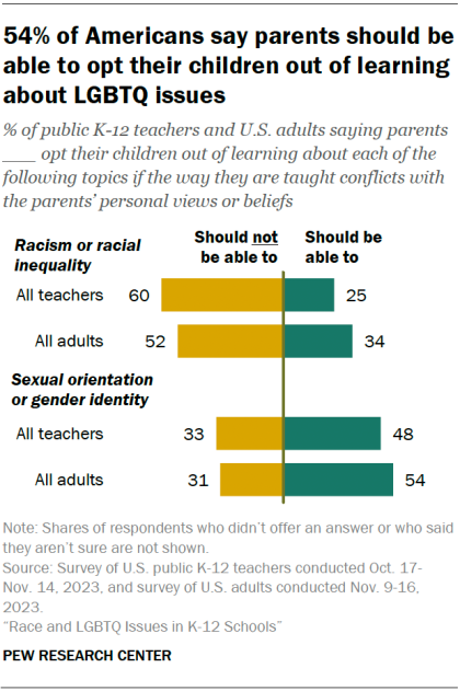
Photo courtesy from Pew Research Center
The Board’s Stance
The MCPS District and Board officials believe the no opt-outs policy is benign and well-intended. A MCPS official claimed that permitting opt-outs would lead to “significant disruptions in the classroom environment” and subject students to “social stigma and isolation” when students left class to avoid LGBTQ+ topics. One Board member professed that the books were for a literacy curriculum, not for explicit instruction on sexuality or gender. Another Board member stated that she “felt ‘kind of sorry’” for the student who favored opt-outs and “wondered to what extent she may have been parroting dogma learned from her parents.” The Board member continued, saying, “[I]f [parents] want their child to receive an education that strictly adheres to their religious dogma, they can send their kid to a private religious school.” The Board member then indirectly compared parents who objected to the new curriculum to “white supremacists” and “xenophobes.”
The Board still allows children to opt out of “family life and human sexuality” instruction, in compliance with Maryland law requiring such opt-outs to be available. Code of Md. Regs., tit. 13a, §04.18.01(D)(2)(e)(i) (2025). Under the GRRD, students can also opt out of noncurricular activities.
MCPS is not alone in having an LGBTQ+ curriculum or in its reasons for doing so. California, Connecticut, New Jersey, Colorado, Oregon, Illinois, Washington, and Nevada all have some form of inclusivity curriculum. These include teaching the history, culture, and ideas of LGBTQ+ populations. Nevada begins its inclusivity curriculum in kindergarten, just like what MCPS wanted to do. Some studies show that inclusivity programs reduce bullying and harassment based on sexual orientation and gender identity.
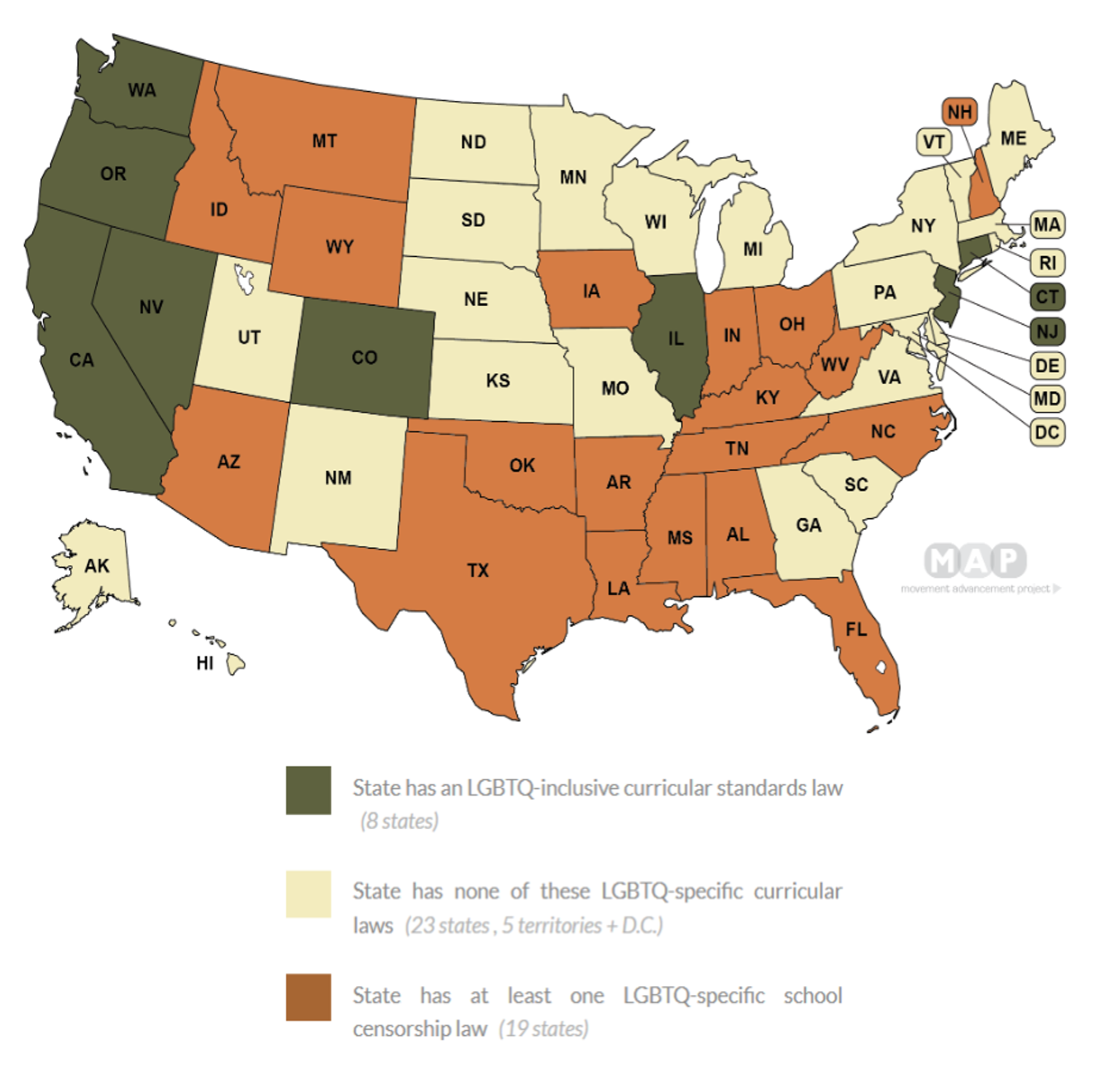
Photo courtesy of Movement Advancement Project.
The Supreme Court’s Decision
In a 6-3 decision, the Supreme Court granted the parents’ request for injunctive relief. The Court also held that the parents are likely to succeed on their claim that the Board’s policy unconstitutionally infringes on their right to free exercise of religion.
To rule on injunctive relief, the Court first had to decide the merits of the case. The Court, citing Yoder, applied strict scrutiny to the Board’s generally applicable policy and weighed the Board’s interest against the parents’ rights. Strict scrutiny is the highest standard used when evaluating constitutional issues. nder this standard, the Board must have a compelling interest and show that the no opt-outs policy was narrowly tailored to that interest.
The scales tipped in the parents’ favor. The Court found that the LGBTQ+ curriculum, the Board’s refusal to provide advance notice to parents, and the no-opt-outs policy “substantially interferes with the religious development” of the children and impermissibly burdens religious exercise. Under the First Amendment’s Free Exercise Clause, parents have the right to direct their children’s education, especially when it conflicts with religious beliefs. This right applies regardless of whether parents send their children to public or private school. Thus, the Court found the curriculum hostile to the parents’ religious beliefs and objectively dangerous to the free exercise of religion.
Damaging Decision or Righteous Ruling?
The decision has been met with glowing and critical opinions. Justice Sotomayor and the other two liberal justices dissented. In Justice Sotomayor’s dissent, she wrote that frequent classroom disruptions and absences will harm students’ learning and development, students will miss out on learning about other backgrounds, and that schools will be overwhelmed with opt-out requests.
Some see the decision as a slippery slope. Elly Brinkley, lawyer for PEN America’s U.S. Free Expression Programs, claims, “by allowing parents to pull their children out of classrooms when they object to particular content, the justices are laying the foundation for a new frontier in the assault on books of all kinds in schools. . . . In practice, opt-outs for religious objections will chill what is taught in schools and usher in a narrower orthodoxy as fear of offending any ideology or sensibility takes hold.”
On the flipside, Eric Baxter, the lawyer who represented the parents, hails the decision as “a historic victory for parental rights. . . . Kids shouldn’t be forced into conversations about drag queens, pride parades, or gender transitions without their parents’ permission.” Regardless of the decision’s positive and negative feedback, schools should
Rights in Jeopardy
This decision could lead to more opt-outs and constitutional conundrums. Some fear that the Mahmoud decision erodes safeguards on generally applicable statutes. Generally, the government can regulate religious expression if its law is neutral or generally applicable. The Court carved out an exception in Yoder, holding that strict scrutiny applies against such a generally applicable government action when an individual’s interest in free exercise of religious expression outweighs a state’s compelling interest. Mahmoud reiterated that carveout, and some fear that it will soon engulf the general rule. Campbell Scribner, assistant professor at University of Maryland, observes that “by making this sweeping decision, everyone is going to object to anything now. And why wouldn’t they? If people were worried about this setting an unworkable standard, it will definitely do that.”
Writing for the Congressional Research Service (CRS), Whitney Novak anticipates that strict scrutiny will readily apply to neutral or generally applicable government actions that jeopardize parents’ religious freedom to direct their children’s development. Novak also noted that it is uncertain how Mahmoud will apply, since the dissent argued that the majority’s factor test lacked “meaningful limits.” If Congress wanted to implement federal K-12 policy initiatives, it would need to exercise its spending power under the Elementary and Secondary Education Act. Otherwise, existing federal law and federalism principles prohibit Congress from controlling the state school’s curricula.
The decision also collides with free speech rights and civil rights. The Department of Education found that a public school district may have created a “hostile environment” by removing books with LGBTQ+ themes, thereby violating Title VI of the Civil Rights Act of 1964 and Title IX of the Education Amendments of 1972. Thus, in efforts to satisfy the religious expression demands of parents, schools face the threat of infringing on other equally vital rights.
Mahmoud is already being used to limit speech on the other side of the political aisle. In fact, one Arkansas court has already cited Mahmoud in its reasoning that state law mandating the display of the Ten Commandments in K-12 public school classrooms is coercive, rather than passive. The law violated the parents’ First Amendment rights and did not pass strict scrutiny. The display of is analogous to the placement of LGBTQ+ books on the shelf; neither is required to be read, but both are readily visible to students who may not feel free to avoid or contest them.
A Final Decision is Yet to Come
As schools seek to address the ongoing debate surrounding LGBTQ+ curricula, they must be careful not to fall short on the recent precedent set by the courts. Meanwhile, parents can find refuge in the right to educate their children in accordance with their religious beliefs. Mahmoud was not the final decision; the merits of the case must still be decided in a lower court. Yet, it is doubtful that a lower court will disagree with the Supreme Court’s determination that the LGBTQ+ curriculum, absent an opt-out policy, likely violates the free exercise of religion.