
In recent months, armed and masked federal agents have roamed the streets of Charlotte, Durham and Raleigh, conducting what many describe as a “dragnet” of our communities. From smashing car windows to dragging workers out of their places of employment, the Department of Homeland Security’s (DHS) “Operation Charlotte’s Web” has left a trail of trauma…
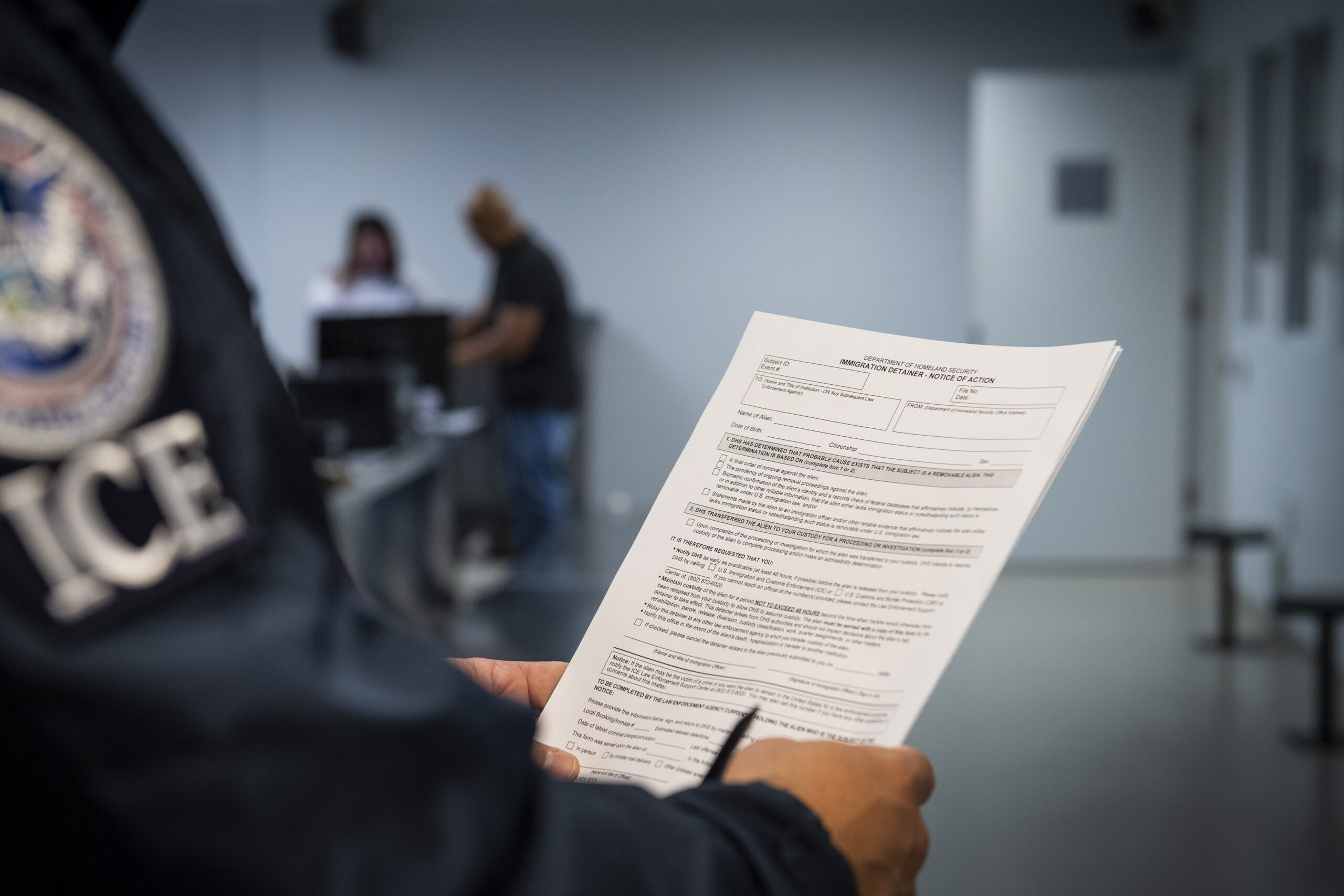
In recent months, armed and masked federal agents have roamed the streets of Charlotte, Durham and Raleigh, conducting what many describe as a “dragnet” of our communities. From smashing car windows to dragging workers out of their places of employment, the Department of Homeland Security’s (DHS) “Operation Charlotte’s Web” has left a trail of trauma across North Carolina. As a civil rights attorney, I am frequently asked by fellow practitioners and concerned citizens: can we actually sue Immigration and Customs Enforcement (ICE)?
The short answer is: Yes. The long answer is: It depends heavily on the remedy you seek, the statute you invoke, and where your client was when the agents approached.
The “Yes” – Habeas and Due Process
If you are seeking the immediate release of a client unlawfully detained in the interior of the country (i.e. away from the physical borders or ports of entry), the writ of habeas corpus remains a potent, if embattled, tool. This legal mechanism requires law enforcement to produce a detained person before a court and justify their imprisonment, but it puts the burden of proof on the detainee to prove that their detention is contrary to the law. Recent victories in the Southern District of New York – specifically Ahmadi v. Almodovar and Han v. Bondi – provide a roadmap for challenging ICE’s current “detain-first, justify-later” tactics.
In both cases, Federal District Judge Vernon Broderick rejected the government’s attempt to apply mandatory border detention statute 8 U.S.C. § 1225 to individuals already living in the United States. This statute creates a mandatory hold and does not require the government to provide a bond hearing or individualized assessment of whether the detainee is a flight risk or danger to the community. The courts found that for interior arrests, 8 U.S.C. § 1226 governs. This statute requires an individualized custodial determination, which is a case-by-case legal assessment by DHS or ICE to decide whether the detainee is a flight risk or danger to the community. Without this process, detention violates fundamental Due Process guaranteed by the Fifth Amendment.
Furthermore, the United States Court of Appeals for the Third Circuit’s recent decision in Michelin v. Warden ensures that successful habeas litigants may be entitled to attorney’s fees under the Equal Access to Justice Act (EAJA), a critical incentive for private civil rights enforcement.
The “But” – The Weakening of Bivens v. Six Unknown Agents
The path becomes significantly steeper if you are seeking money damages for constitutional violations. For decades, Bivens v. Six Unknown Named Agents of Federal Bureau of Narcotics, allowed victims to hold federal officers liable for individual misconduct by recognizing a constitutional damages remedy against a federal agent. However, the Supreme Court has recently taken a sledgehammer to this precedent.
In Egbert v. Boule, the Court effectively shut the door on Bivens claims arising in the “new context” of immigration enforcement at the border. The Court reasoned that Congress, not the judiciary, is better equipped to create damages remedies in matters involving national security and foreign relations. This has created a “legal gray area” where agents may act with impunity, knowing they are unlikely to be held personally liable for even blatant Fourth Amendment violations.
The “It Depends” – FTCA and Injunctive Relief
The Federal Tort Claims Act (FTCA) remains a primary vehicle for seeking justice for physical injuries or property damage caused by ICE agents. But even here, we face the “discretionary function exception,” which can shield officers if their conduct isn’t directly prohibited by a specific federal policy. The Supreme Court recently nudged the Eleventh Circuit in Martin v. United States to reexamine this exception, but for now, the shield remains broad.
Context Is Everything
In the Western District of North Carolina, the class-action lawsuit Aceituno v. USDHS (filed February 2026) represents a critical attempt to secure injunctive relief. The five plaintiffs–all of whom are U.S. citizens or visa holders–allege that the U.S. Department of Homeland Security (DHS) and its agencies are systematically violating the federal warrantless arrest statute, which requires probable cause of both removability and an immediate escape risk. By filing this lawsuit seeking to declare these policies unlawful, the American Civil Liberties Union of North Carolina (ACLU-NC), the American Civil Liberties Union (ACLU), Democracy Forward, and the Southern Coalition for Social Justice (SCSJ) aim to secure judicial intervention against these systemic departures from federal warrantless arrest requirements before they might result in the tragic use of force, like was recently seen in Minneapolis.
Our role as practitioners is to anchor the “judicial backstop” against executive overreach. We must be creative, utilizing Freedom of Information Act (FOIA) litigation to force transparency, as seen in the ACLU’s 2025 lawsuits regarding ICE detention expansion in Virginia and North Carolina.
The remedy to frustrations and perceived shortcomings with our immigration system is to work within the framework of the Constitution – not to flout it. As the court noted in H.C.R. v. Noem regarding access to counsel at “Alligator Alcatraz,” constitutional rights are not a privilege–they are a guarantee for all people in this country. Whether through habeas petitions, FTCA claims or class-action injunctions, we must continue to hold power to account, case by hard-fought case. Our approach to immigration should be rooted in nuance and legal authority.

Lead civil rights lawyer at the Law Offices of James Scott Farrin.