
Restorative approaches put relationships first, helping families resolve conflict and repair harm in ways the courtroom can’t.
Introduction
In family law, the structure reflects that of the criminal and civil system, with a judge who determines the ultimate outcome, but restorative justice offers an alternative that can better serve families’ long-term needs. The typical adversarial framework makes sense when the goal is to adjudicate blame or enforce someone’s rights. However, family conflicts are not centered on guilt or innocence; they revolve around relationships. After litigation ends, parents must co-parent for years, and children depend on stable family relationships long after any court order is signed.
Yet, the system relies on an adversarial model that threatens to deepen conflict rather than resolve it. Stephen Erikson, one of the founders of divorce mediation, argues that this adversarial process creates “a toxic river that drowns every mother, father, husband, wife, and child who wades into it.” Erikson framed this potential harm not as a failure of the legal system, but as a consequence ingrained in the adversarial model itself. The courtroom processes we rely on—rules, rights, and punishment—are important for public safety and judicial efficiency; however, they often fail to address the emotional and social harm that family conflicts create.
Restorative justice provides an alternative legal framework focused on repairing harm, fostering accountability, and restoring relationships. This theory centers on a non-hierarchical, consensus-driven process that values both equality and collective accountability. While traditionally applied to juvenile conflicts, workplace disputes, and criminal proceedings, restorative justice is now expanding into family law—a field where legal decisions are deeply intertwined with personal relationships.
The Adversarial Method of Family Law
The family law system has long been criticized as being adversarial, inefficient, and emotionally destructive. Common family law cases include divorce, alimony, equitable distribution, child custody, child support, domestic violence, and others. Litigation often lasts years, draining financial resources and deepening emotional wounds as parties fight over property, finances, and determining a child’s “best interests.” This is North Carolina’s current legal standard for child custody, which is aimed at ensuring the child has a safe and stable home. However, this is often a difficult determination with many factors playing a role.
In divorce, conflicts over property and custody often cost thousands of dollars, while placing significant strain on trust and communication. On average, a divorce in the United States costs $9,970 and can exceed $20,000 in contested cases, yet that money only buys a legal victory. Even when both parties want to separate peacefully, the system often turns cooperation into competition. Meanwhile, custody disputes present another challenge: judges must decide what is in a child’s “best interest” based on a brief hearing and written reports, often without speaking to the children themselves. Yet, the fundamental emotional needs of both parents and children go unnoticed and unaddressed.
Then in domestic violence cases, the victim’s safety is a priority, but their voices are frequently reduced to evidence. Trauma gets compressed into questions on the stand, and their need for accountability and healing becomes secondary to procedural outcomes like protective orders. While it is important for courts to follow rules and procedures, there needs to be a more modern approach that balances the nuances of human emotion with the rigid structure of court room operations.
As Chief Justice Mark Cady stated, “A system that requires an adversarial approach and lacks a clear, understandable process is hurting families and adding to a distrust of our courts overall.” Against this background, restorative justice offers an approach that raises a different possibility: family courts designed to repair harm rather than determine fault.
What Restorative Justice Really Means
Restorative justice is based on a philosophy that centers on identifying who has been harmed, understanding their needs, and determining who is responsible for addressing those needs. Within this framework, both the person harmed and the person who caused harm are equally important. Restorative justice takes several forms to advance these goals, including community conferences, peacemaking circles, victim-offender dialogues, and family group conferencing. Each model relies on structured, facilitated conversations where all parties are heard. These processes safeguard the needs of those harmed while ensuring obligations and accountability are openly addressed.
Restorative justice is guided by several core principles that shape its approach to addressing harm and conflict. Repairing harm focuses on restoring what was lost or broken for victims, relationships, and communities rather than simply punishing the offender. Active accountability requires the person who caused harm to take genuine responsibility and work toward making things right. Voluntary participation ensures all parties engage freely and without coercion, fostering honest dialogue. Inclusive dialogue brings everyone affected by the harm together in a structured conversation where each voice is heard and a collaborative path forward is established. Finally, reintegration supports both the victim and offender in returning as valued community members, helping the offender rebuild while aiding the victim in healing and reclaiming a sense of safety and belonging.
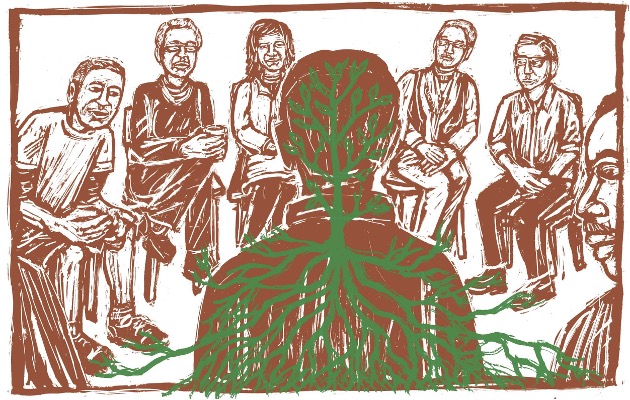
There are also some unique activities where RJ is practices, such as in peach circles. To demonstrate, circles create a safe space where parties can speak openly, listen to one another, reflect on what led to the harm and how it has affected everyone involved. A talking piece gets passed around, ensuring that only one person speaks at a time and that everyone has had the chance to be heard without interruption.
The foundation of restorative justice rests on the understanding that all humans are “rooted in relationships.” This aligns naturally with the objectives of family law, which deals with ongoing relationships that no court order can completely sever. Family law’s focus on “the best interests of the child” fits neatly with restorative justice’s commitment to long-term well-being rather than short-term legal victories. As Kay Pranis, a leading restorative justice practitioner, explains, “We cannot necessarily undo harm that happened, but we can move toward healing and toward being more constructive with one another.”
Restorative Justice Turns Family Conflict into Conversation
Mediation is an alternative dispute resolution available to, or mandated for, families navigating their family law related dispute. It relies on a neutral third party to guide opposing parties toward a mutually acceptable agreement. However, mediation has significant limitations. Power imbalances can distort the process when one party holds greater emotional, financial, or psychological control. More fundamentally, mediation’s focus on reaching an outcome can lead to overlooking the deeper underlying issues. For some families, mediation works well; for others, it shuts the door on any meaningful opportunity for repair.
Restorative practices offer something different. As Richard Waugaman, family law professor at Campbell Law and director of the Gailor Family Law Litigation Clinic, explains, “Restorative justice is a process of healing that may or may not involve agreement; the ultimate goal there is understanding. Mediation is the inverse; we are trying to get the parties to agree, even if there is no healing or understanding. Where restorative justice is process-oriented, mediation is in large part outcome-driven.” This perspective highlights how restorative justice prioritizes healing and understanding over simply reaching an agreement, setting it apart from traditional mediation.
Where mediation appears to be transactional, a restorative justice approach can be transformational. Jon Powell, restorative justice clinic director at Campbell Law, offers a unique perspective, “In restorative justice, we are not trying to find that place in the middle where we can settle on something. It’s a transformation that we are working towards; hopefully, a transformation for someone that’s hurt and a transformation for somebody that’s responsible for the hurt.”
This distinction matters because no two families are the same. Restorative justice has no “one size fits all” approach. Any process that facilitates healing and understanding can be adapted to meet the specific needs of each family. As Lord Igor Judge, former Lord Chief Justice of England and Wales, observed, “In cases involving the care and future of children, I have the most serious reservations about whether the adversarial system is in any way to the advantage of the child.” Restorative justice practices can offer a safe space for families to resolve conflicts and repair relationships.
Restoration of Custody Conflicts
In Cook County, Illinois, Judge Martha Mills partnered with local restorative justice practitioners Peter Newman and Elizabeth Vastine to pilot a circle-based approach to custody disputes. The program’s goal was to help families problem-solve and reach co-parenting agreements outside of emotionally and financially draining court proceedings, while still allowing judicial intervention when needed. Most cases that entered the circle process resulted in agreement; some families never returned to court, while others returned to resolve discrete issues such as child support modification. This pilot project demonstrates that restorative justice can be successfully integrated into family law.
The circle process works because it creates a space for respectful communication, which is imperative to parties going through separation or custody changes. By allowing only one person to speak at a time, circles ensure each parent is genuinely heard, addressing communication gaps that may have existed in the relationship. This structure also enables uninterrupted dialogue, mitigating the risk of coercion that can arise in traditional mediation.
More importantly, the circle process assists parents in repairing and maintaining their relationship. This is crucial since most parents must continue coparenting even after a dissolution order. Reflecting on her facilitation work, Elizabeth Vastine observed, “The circle process can break down barriers, change communication patterns, and start to build relationships, sometimes even trust, within families so that parents can learn ways to better communicate and co-parent to provide their children with a sense of security, stability, and consistency.”
Custody mediation often falls short of resolving disputes. In North Carolina, during the 2023-24 fiscal year, mediators conducted 9,265 custody mediation sessions but produced only 3,967 parenting agreements. That is less than a 50% “success” rate. Families who proceed to litigation can face costs ranging from $5,000 to $40,000 or more. Beyond the financial burden, contested custody battles take an emotional toll that no settlement can fully address. The Cook County pilot demonstrates that restorative justice offers a viable and effective alternative.
Recognizing the Limits of Restorative Justice
Restorative justice is not a universal solution, and advocates must acknowledge its limits; it cannot replace the legal system entirely. First, restorative justice only works when participation is truly voluntary. As Richard Waugaman notes, “You have to have people who want to be restored, and to want to be restored, you have to have someone who knows they were broken and or that they broke someone else.”
The limitations are especially pronounced in cases involving domestic violence. When one party has systematically controlled, intimidated, or abused the other, bringing them together, even with a skilled facilitator, can re-traumatize the survivor and give the abuser another platform for manipulation. While some practitioners argue that carefully designed circles with extensive safety protocols can work in limited domestic violence cases, the risk remains substantial.
Further, some cases require judicial intervention to protect vulnerable parties, enforce agreements, or provide finality of a court order. These limitations do not invalidate restorative justice; rather, they define its proper scope. The goal should be to create a hybrid system that allows families to choose restorative processes when appropriate, while ensuring legal safeguards remain available when necessary.
The Role of Lawyers, Law Students, and the Next Generation
Law students, practitioners, and judges increasingly acknowledge that success in family law does not always mean justice or equity. For the next generation of lawyers, embracing restorative principles means learning to see familial conflict not as a battle to win, but as harm that needs repair.
Law schools are well-positioned to drive this shift. Clinics focused on restorative justice, mediation, and family law practice can equip students with the skills to facilitate difficult conversations and design more trauma-informed legal processes. Jon Powell observes that legal education should go beyond doctrine and procedure, “Law schools ought to provide more than legal skills; to have some training, being able to hold trauma-informed conversations is equally important.” In his view, being a lawyer is not only about being an advocate but also a listener, someone who can sit with complexity and meet clients where they are.
What begins in the classroom can transform the courtroom. A lawyer’s role in restorative justice is not adversarial; it is inquisitorial–focused on understanding rather than winning. Lawyers can serve as facilitators rather than fighters, guiding people toward healing and mutual comprehension. By weaving restorative practices into both legal education and family court processes, the law can better reflect the human needs it was created to serve.
Family Law as a Natural Home for Restorative Principles
While custody disputes offer the most immediate application, restorative justice principles can extend across the full spectrum of family law. Circle processes, for instance, can help separating couples identify not just what they are entitled to, but what they genuinely need to move forward, opening space to discuss what financial security looks like for each of them post-divorce. Rather than treating property as something to be divided and fought over, parties can together determine what arrangements would allow both to rebuild their lives, honoring their shared history rather than erasing it.
That same spirit of collective problem-solving carries into child welfare. Family group conferencing is already used in placement decisions, gathering extended family members to jointly create safety plans and identify who can provide care, rather than leaving a child’s future solely in the hands of caseworkers and judges. The result is a process that keeps children connected to their communities and their people whenever possible. Restorative justice is not a replacement for legal protection; it is a recognition that healing and justice can operate in tandem, supporting families as they find their way forward together.